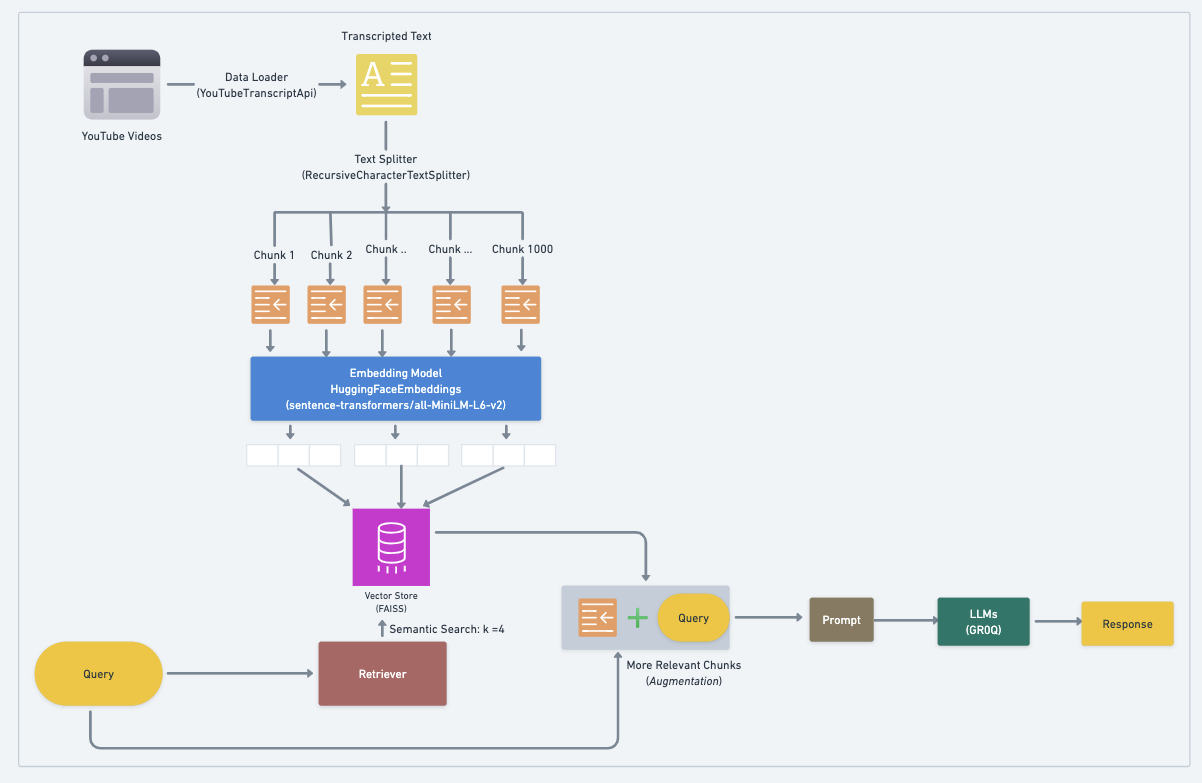
Content consumers, students, and researchers frequently spend significant time watching YouTube videos to extract insights, summaries, or answers to specific questions—a process that is inherently inefficient for knowledge workers. To address this challenge, I developed RAGTube, an AI‑driven assistant that leverages Retrieval‑Augmented Generation (RAG) techniques to convert raw video transcripts into semantically searchable knowledge. The goal was to build a system that can ingest a YouTube video URL, extract its transcript and metadata, and then let users pose natural language questions with immediate, context‑aware answers.
I implemented a pipeline that begins with fetching the video transcript from the YouTube API and processes it into text chunks suitable for embedding. These embeddings are stored in a FAISS vector database for efficient semantic search. Using a combination of LangChain and a large language model (LLM) backend, RAGTube retrieves relevant text segments based on the user’s query and produces coherent, informative responses that directly reference the video content. The system includes an interactive Streamlit interface, which guides users through URL submission, transcript retrieval, and conversational Q&A within the same application.
RAGTube transforms long‑form video content into actionable knowledge by enabling targeted questioning and summarization without manually watching entire videos. This project demonstrates applied expertise in vector search, RAG workflows, LangChain orchestration, API integration, and user interface development, all of which are key competencies spotlighted on my resume. The repository on GitHub contains the complete codebase, documentation, and deployment instructions, making it a replicable reference implementation for future work in multimedia NLP and AI‑augmented information retrieval.