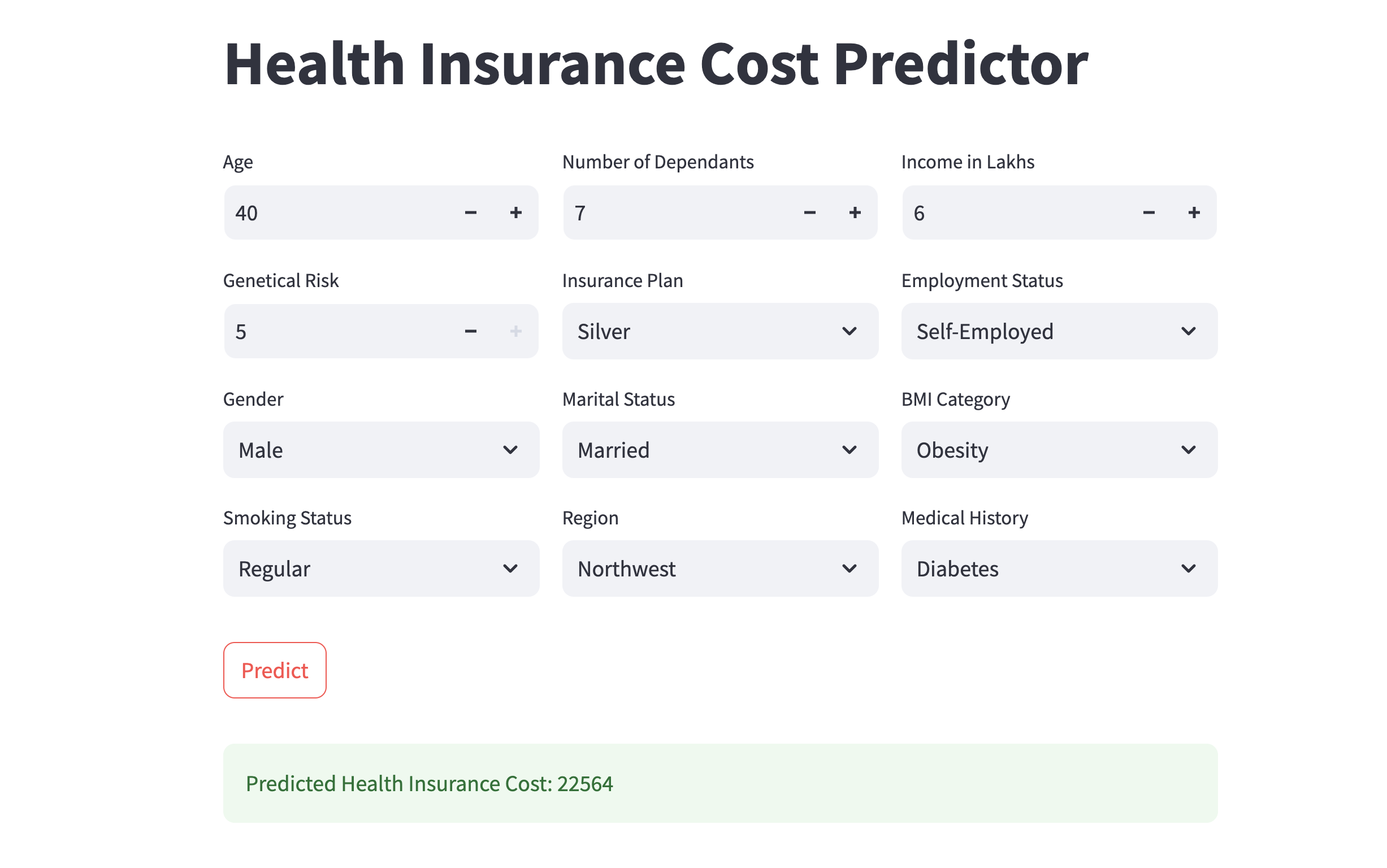
The Health Insurance Cost Predictor is an analytics and predictive modeling system designed to estimate individual health insurance expenses based on demographic and lifestyle factors such as age, BMI, number of children, smoking status, and region. This project draws on structured dataset patterns and real-world use cases in insurance risk analysis, reflecting skills in both statistical modeling and business problem framing — competencies highlighted in my professional profile.
To build an accurate and interpretable prediction model, the project executes a complete data science pipeline: data ingestion and cleaning, exploratory data analysis, feature engineering, selection of regression algorithms, hyperparameter tuning, and validation. Missing values and categorical data are handled with appropriate transformers, and models are evaluated using common metrics such as RMSE and R² to ensure reliability. The final model is deployed via a Flask web service, complete with a user interface that allows stakeholders to input customer attributes and instantly receive cost predictions. This implementation demonstrates practical expertise in Python, Pandas, Scikit-Learn, regression modeling, and serving machine learning models through web APIs.
By converting raw insurance data into actionable predictions, this system delivers a tool that enables business analysts and insurance planners to simulate cost outcomes given specific customer profiles. It integrates sound feature engineering and model evaluation practices to optimize predictive accuracy, empowering evidence-based decisions. The final deliverable showcases high calibre machine learning project skills, including full ML lifecycle management, model deployment, and user-oriented interface design.