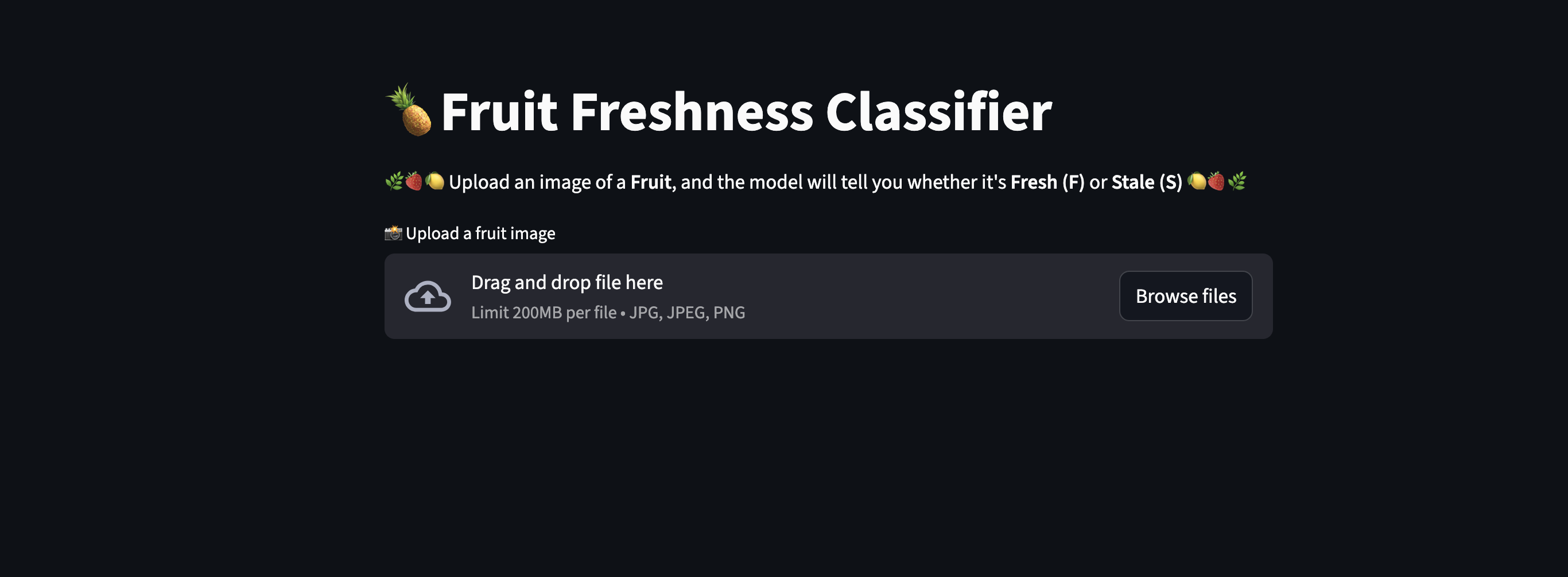
Cold storage logistics and fresh produce distributors face systematic challenges maintaining product quality due to reliance on manual inspection processes that are slow, inconsistent, and prone to human error. To address this operational inefficiency within FreshHarvest Logistics workflows, I led the development of an automated stale vs. fresh fruit classification system using deep learning, aiming to reduce waste, support rapid quality control, and deliver a scalable, replicable solution.
I implemented a series of computer vision models in PyTorch, starting with a custom baseline CNN and progressing to more advanced architectures via transfer learning. Using the ResNet50 pretrained model, I extracted robust image features across a 16‑class fruit dataset, and applied Optuna‑based hyperparameter tuning to optimize key parameters such as learning rate, batch size, and dropout. I evaluated model performance with accuracy, precision, recall, and F1‑score metrics, achieving enterprise‑grade classification results. In addition to model development, I curated and structured training, validation, and test datasets, handled image preprocessing and augmentation, and documented reproducible training workflows.
The final ResNet50 transfer learning model achieved near‑perfect classification accuracy and strong evaluation metrics on held‑out data, proving the effectiveness of the automated solution over manual inspection. This work demonstrates proficiency in deep learning, model optimization, and scalable image classification — all of which directly align with machine learning engineering and applied AI competencies featured on my resume. The project codebase and documentation on GitHub support reproducibility and future extension, such as backend API deployment or real‑time inference integration within supply chain systems.