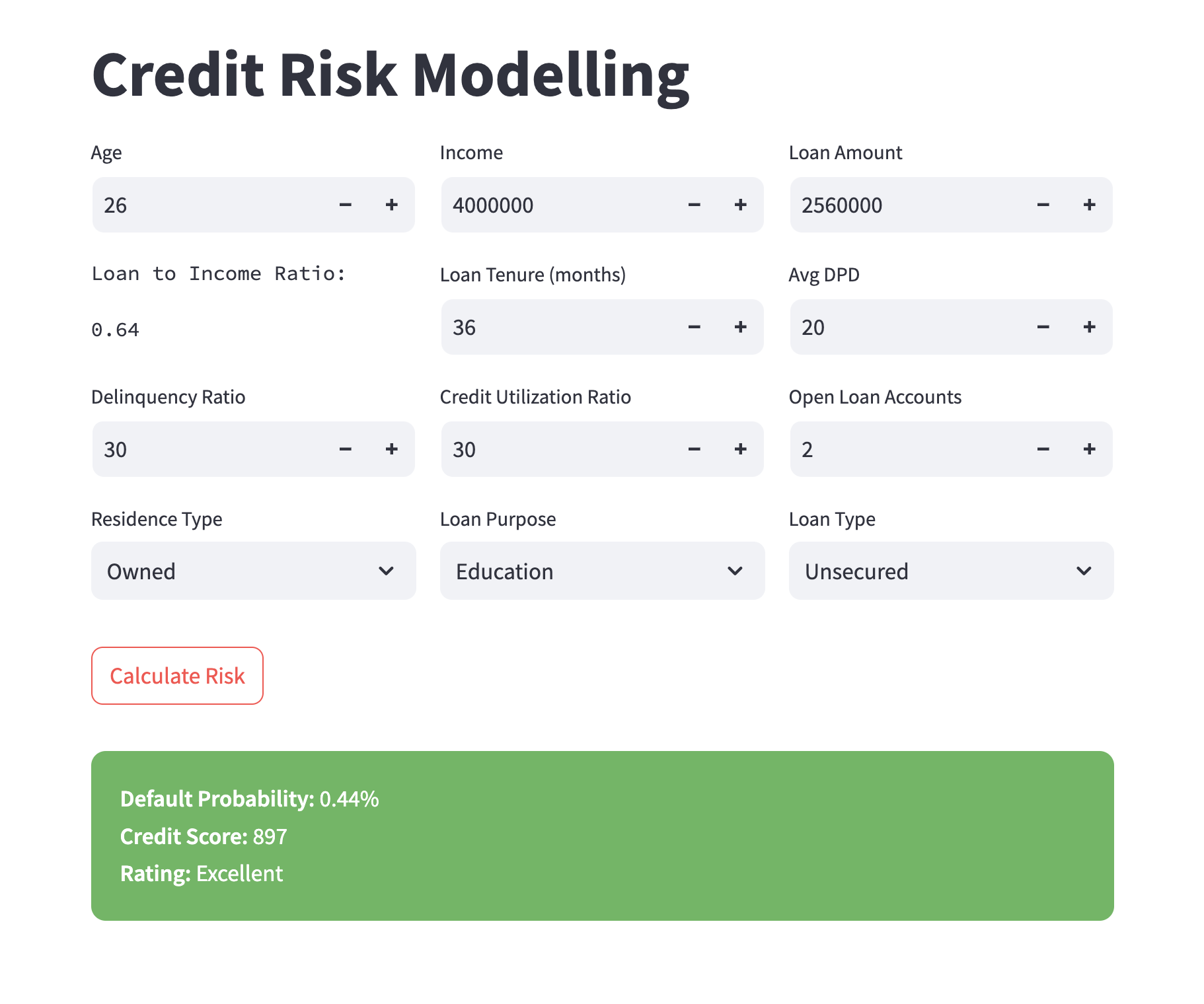
The Credit Risk Model for NBFC project addresses the critical challenge of predicting default risk for loan portfolios managed by non-bank financial institutions. By modeling customer financial behavior and demographic risk factors, the system supports more informed lending decisions — a key operational priority in financial risk management. This work reflects my experience building structured statistical models and data-driven decision systems.
To evaluate creditworthiness, the workflow begins with data preprocessing, including handling missing values, encoding categorical variables, and scaling features to prepare for modeling. Multiple classification algorithms such as Logistic Regression and Random Forest are trained and tested, with hyperparameter tuning to optimize performance and prevent overfitting. Standard model evaluation metrics such as accuracy, precision, recall, F1 score, and ROC-AUC are used to assess performance rigorously. Feature importance analysis and business-relevant interpretation techniques are incorporated to ensure model transparency for stakeholders.
The resulting system enables NBFC decision-makers to estimate the likelihood of default before credit allocation, improving portfolio quality and risk mitigation. By integrating multiple candidate models and evaluation benchmarks, the project demonstrates practical machine learning competencies — from feature engineering through model selection and evaluation — and aligns with real-world financial analytics use cases. The final output shows not just technical depth but also business impact, illustrating how predictive modeling can directly influence critical operational outcomes.